Know how to respond to tantrums and meltdowns.

Get practical help with what to say and do, tools to help your child settle, and a plan for the struggles that keep coming back. Over time, help your child build emotional skills and work towards fewer, more manageable hard moments.

For parents of children aged 2 to 9.

New Short audio talks, and Same Page for finding a shared approach with your partner

No account needed. Personalisation stays on your phone. How we handle data

Calm Kit screen: calming ideas made for your child Hard Moment Help for food refusal: Quiet limit approach and Let Neil guide you PrepLab screen: a plan for the struggles that keep returning
Where to start

What's hardest for you at the moment?

Pick the one that sounds most like your house. You'll see how Frazzle helps with it, using real content from the app. You don't need to enter any details.

Picking one here is just for browsing. The app asks its own few questions when you set it up.

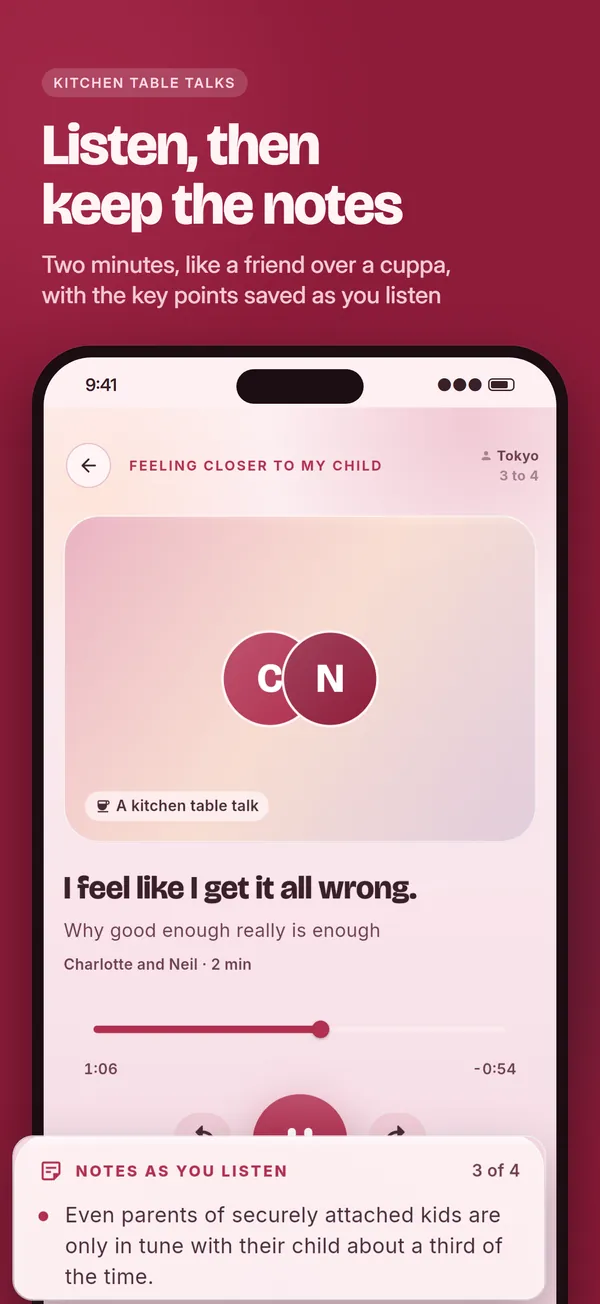
A Kitchen Table Talk playing, with notes appearing as you listen

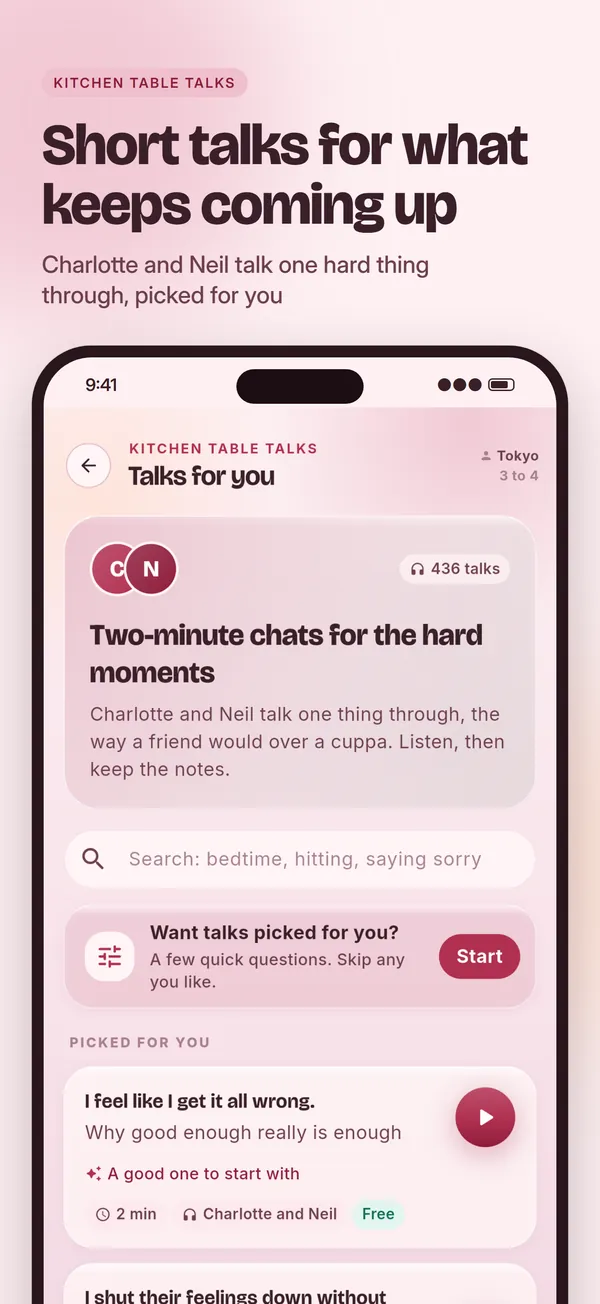
Kitchen Table Talks

Short audio talks for a fresh perspective

Two voices, Charlotte and Neil, talk one parenting problem through, the way a friend would over a cuppa. They are recorded audio talks, not live calls or therapy. Answer a few optional questions and the talks are picked around what you find hard. Most take about two minutes.

Sample talk: "I feel like I get it all wrong."
  • Even parents of securely attached kids are only in tune with their child about a third of the time.
  • The misses are normal. What counts is noticing and coming back.

Try this

"I was busy before and didn't listen properly. I'm listening now."

Then: give them your full attention for a minute.

Listen to the full sample (2 minutes). It only plays when you press play.

Read the transcript

Neil: Can I admit something? Some days I feel like I'm getting it all wrong. I miss what they need, I'm short with them, I'm on my phone.

Charlotte: Oh, Neil. You're in very good company. And I've got some good news for you.

Neil: Please.

Charlotte: Researchers who watch parents and little ones really closely found that even parents of securely attached kids are only in tune with their child about thirty percent of the time.

Neil: Thirty? That's, that's way less than I thought.

Charlotte: Me too, when I first heard it. The rest of the time, there are little misses. They want to play, you're making dinner. They're upset, and you didn't notice straight away.

Neil: So what makes the difference, if it's not getting it right?

Charlotte: It's what happens after the miss. Noticing, coming back, putting it right. That's what kids learn from. That things can go wrong between people who love each other, and get fixed.

Neil: Hmm. So the misses are part of it.

Charlotte: They're part of it. Some research even suggests that responding to around half of a baby's signals can be enough to build that secure feeling. Not every single one.

Neil: That takes a lot of pressure off.

Charlotte: It should. Trying to be perfect can make parents more anxious, and kids pick up on that. What they need is a parent who's good enough. Warm, there most of the time, and willing to come back.

Neil: Good enough. I can do good enough.

Charlotte: You already are.

Neil: So what do I actually do, after one of those misses?

Charlotte: Keep it simple. Go back. Something like, I was busy before and I didn't listen properly. I'm listening now. Then give them your full attention, even just for a minute.

Neil: That's it?

Charlotte: That's it. Short and real.

Neil: Okay. Notice the miss, go back, listen.

Charlotte: And let go of perfect. Your child doesn't need a perfect parent. They need you, coming back, again and again.

Free to try: starter talks marked Free in the app. Notes, the try-this and the line to say are saved for later.


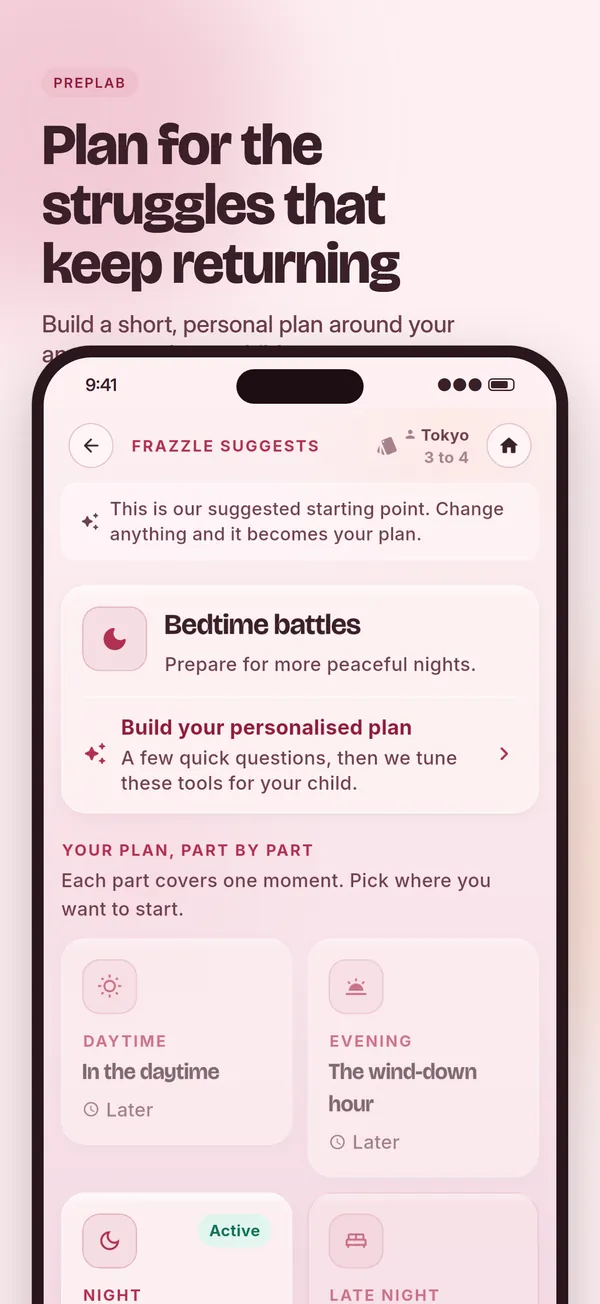
PrepLab plan board built around your answers

PrepLab

A plan for the routine that keeps going wrong

Choose the struggle, answer a few questions about your child, and build a short plan one part at a time: what to set up before, what to do during, and what to try after.

Example: bedtime, ages 5 to 9
  1. The struggleThe extra story, the one more drink, the calling out. Bedtime turns into a battle most nights.
  2. One part of the planFill the cup before separation. A connection moment in the wind-down hour often eases resistance more than firmer rules.
  3. Your next stepTen to fifteen minutes of focused attention on something they choose, built into the evening, not added when bedtime is going badly.

Free to start: one full plan for the moment you pick when you set up. Reminders can bring your plan to you before the moment. Preview strategies for 12 situations

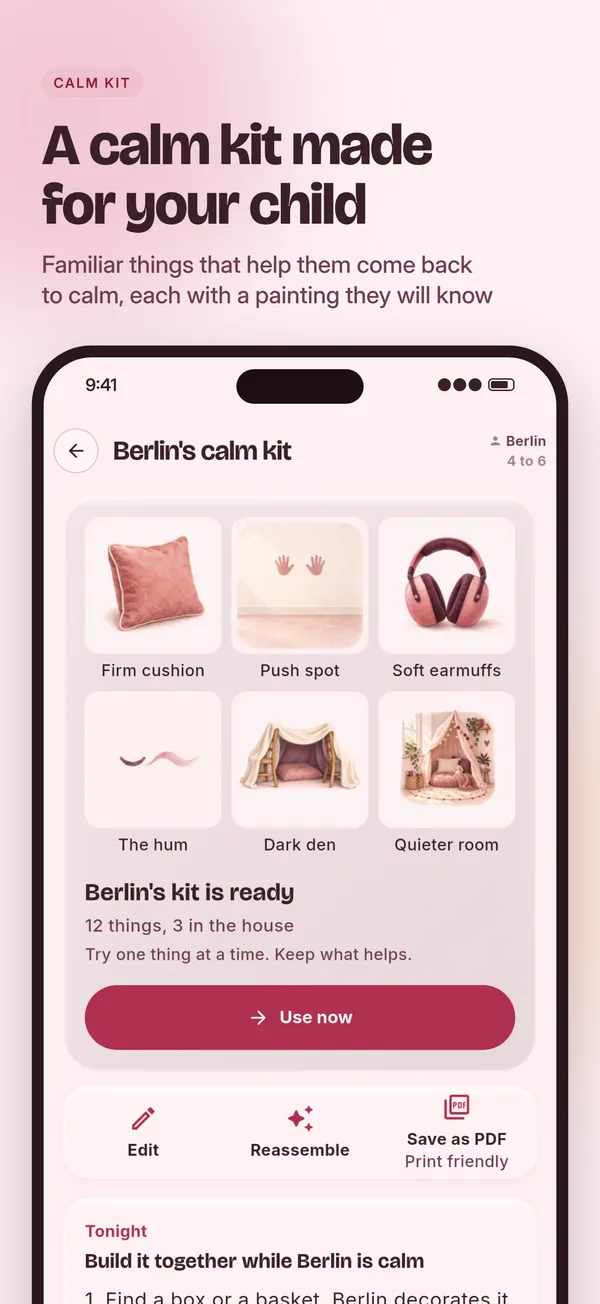
Calm Kit Use now screen: one idea to offer, with the words to say

Calm Kit

Calming ideas made for your child

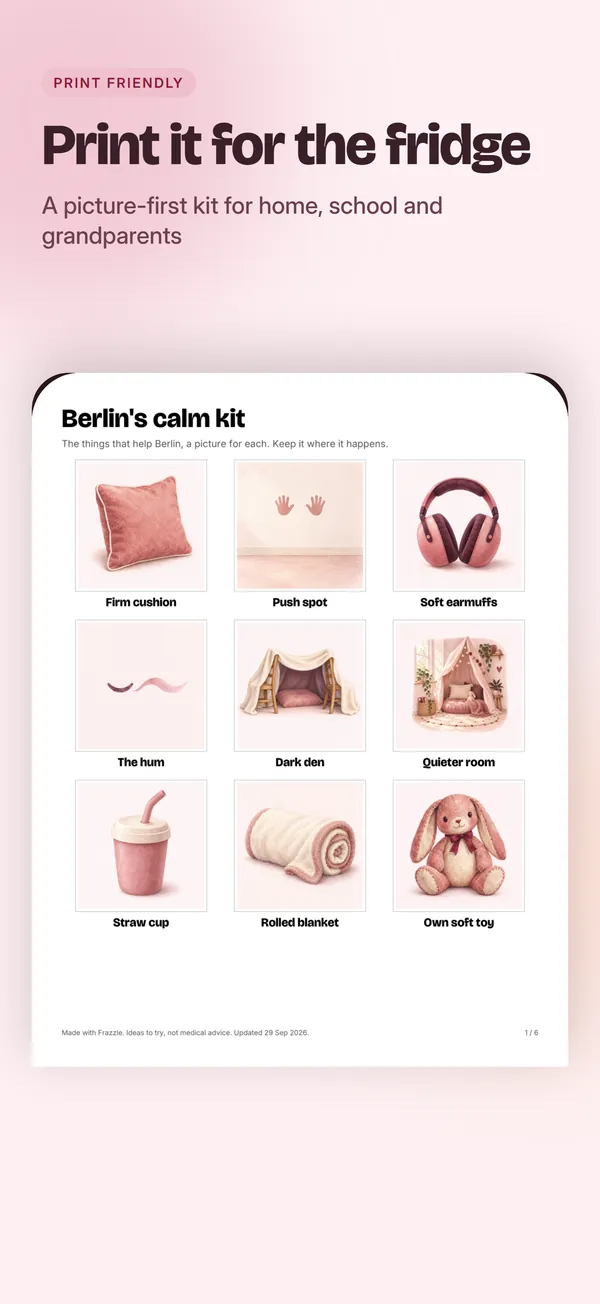
Answer two quick questions and Frazzle builds a kit from over 100 calming ideas, each with a painting your child can recognise. When it gets hard, tap Use now for one thing to offer and the words to say.

Painting of a firm cushion from the Calm Kit
One idea from a kit: Firm cushion

An ordinary firm couch cushion, light enough for your child to move away. Some children enjoy pushing and squashing a firm cushion.

When it's building upLeave the cushion nearby. Your child can squash it with their hands or leave it alone.Your cushion's right here.
At the peakLeave it within reach and say almost nothing. Do not hand it over or ask about it. Dim the room if you can.

Your first kit is free. Mark what you tried and whether it helped, and the kit keeps what suits your child. Print it for the fridge.

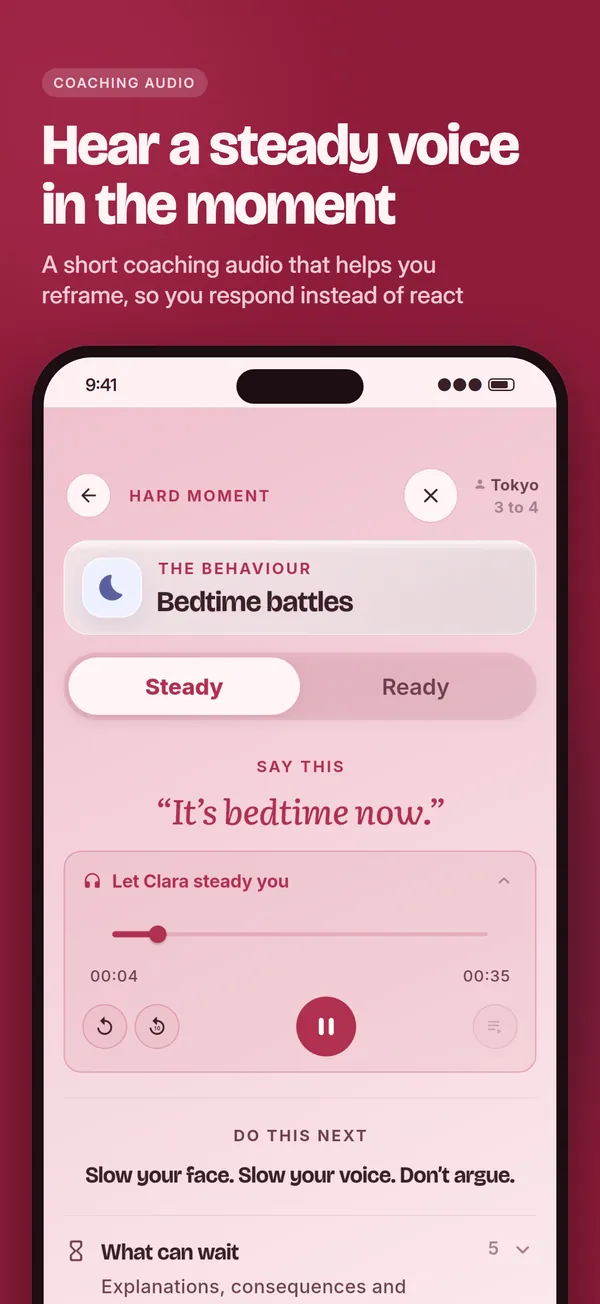
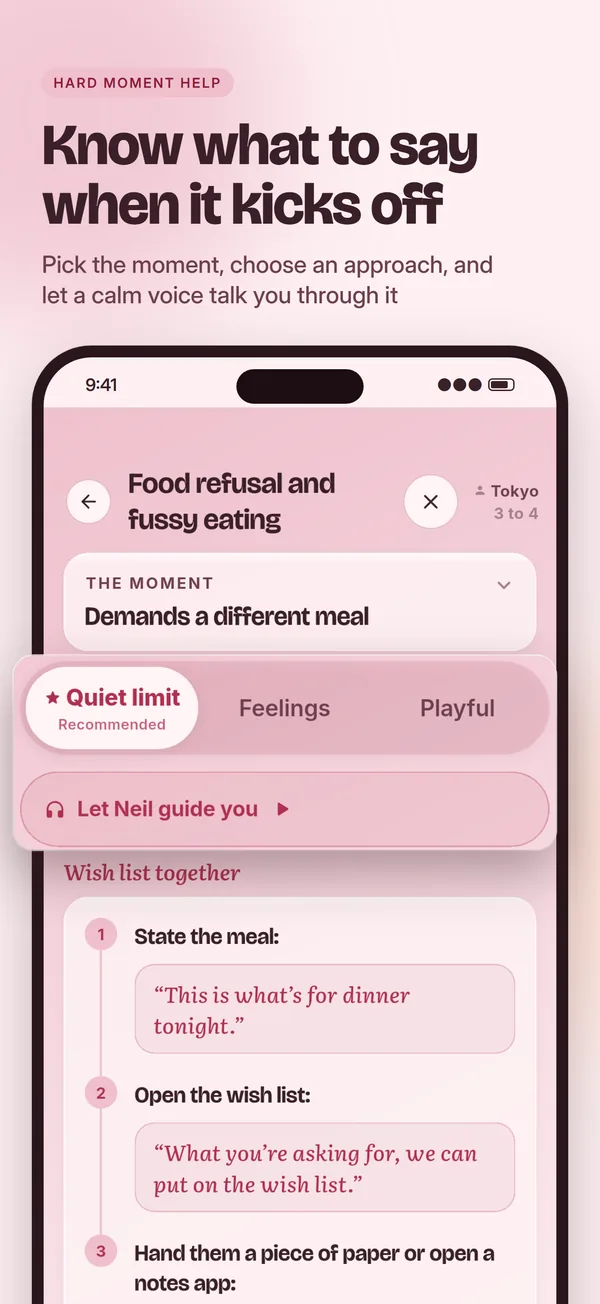
Hard Moment Help for food refusal: the moment Demands a different meal, with the Quiet limit approach chosen and Let Neil guide you enlarged

Hard Moment Help

What to say and do, right now

Pick the exact moment you're stuck in, choose an approach, and get the words for each step. A calm coaching voice can talk you through it, hands free.

Example: food refusal, "Demands a different meal", ages 2 to 4

Quiet limit: wish list together

"This is what's for dinner tonight."

Then: "What you're asking for, we can put on the wish list. What should I write?"

  1. Pick the momentFood refusal, bedtime, hitting, screens and more, each split into the moments that usually get hardest.
  2. Choose an approachQuiet limit, Feelings or Playful. The one that usually fits best is marked Recommended.
  3. Let a voice guide youTap Let Neil guide you for short coaching audio that talks you through the steps.

Free to start: the guide and coaching audio for the moment you pick when you set up. Browse parenting situations

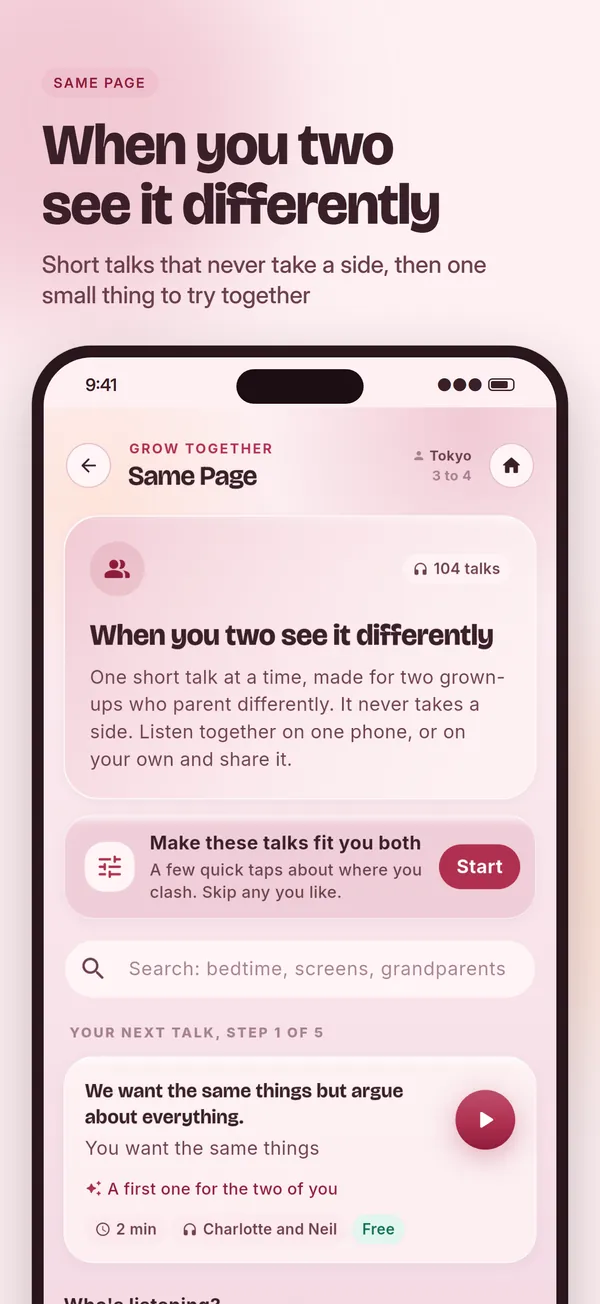
Same Page screen: short talks for two grown-ups who see it differently

Same Page

When you two see it differently

Short audio talks for two grown-ups who parent differently. Each talk hears both sides and never takes one. The aim is a small shared next step, not winning the argument.

  1. 1. ChoosePick where you clash, like firm or soft, or who steps in. Skip any question you like.
  2. 2. ListenTogether on one phone, or on your own for now. Starting alone is a real start.
  3. 3. Agree one thingOne small thing you both do for two weeks, then check how it went.

Not for unsafe situations

Same Page is for everyday disagreements about parenting. It isn't counselling, and it isn't for a relationship where anyone feels unsafe or controlled. If that's you, please contact a local support service or emergency number.

Free to start: the first talk for the two of you, and the talk that helps you plan your one thing.

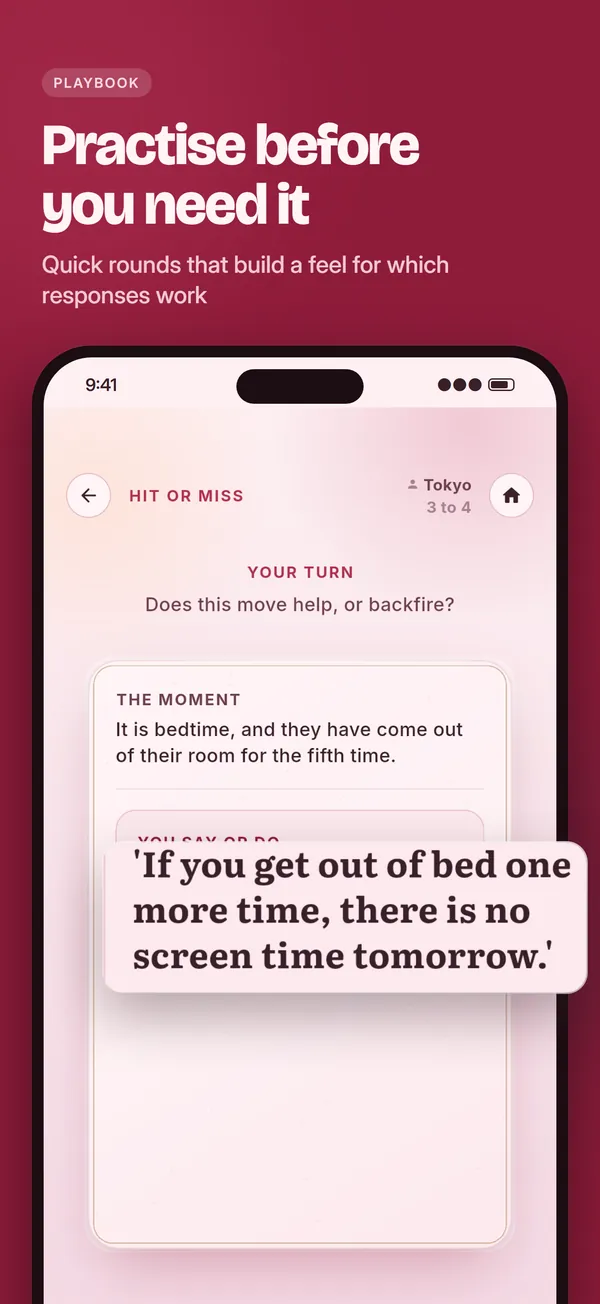
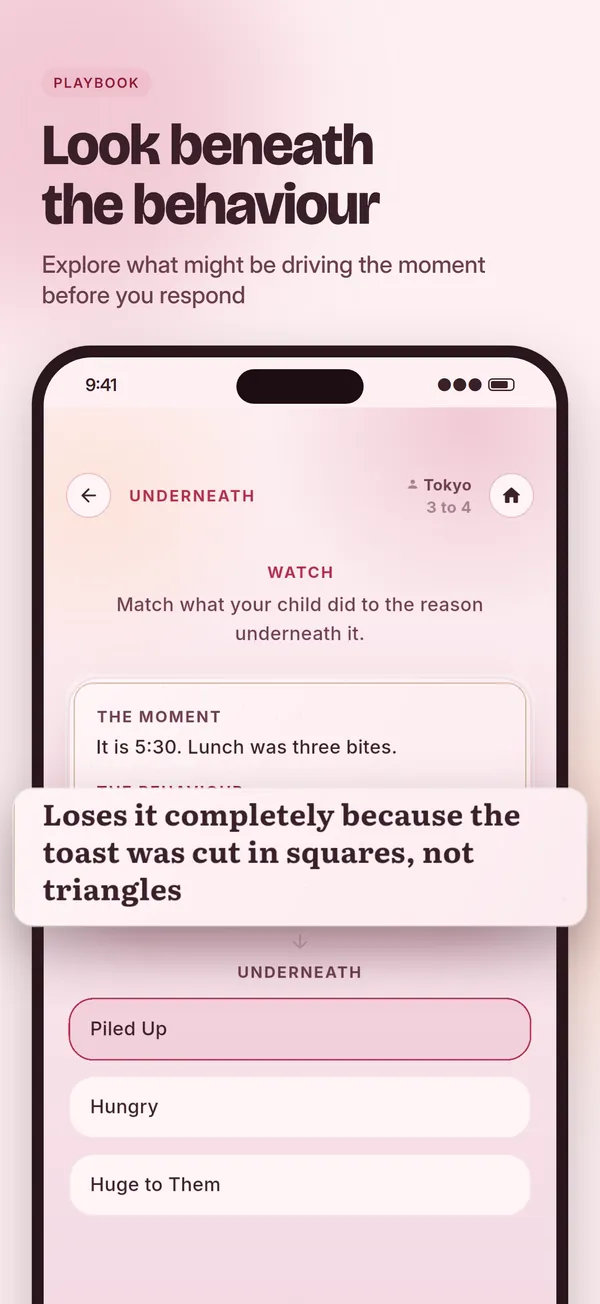
PlayBook practice card: is this response a hit or a miss?

PlayBook

Practise for parents, two minutes at a time

Knowing the response you want is one thing. Reaching for it when you're tired is another. Short games let you practise noticing what's happening and choosing a response, using the situations you find hardest.

They say you are the worst mum or dad ever. First move?

A sample round. Pick one.

Five games, each a couple of minutes, with progress you can see as you go.

How it fits your family

Start with one thing. Add more when you're ready.

You don't need to learn the whole app on day one.

  1. Choose a starting point

    When you first open Frazzle, it asks what's hardest for you at the moment, with the same six choices as above. Pick one, or just explore.

  2. Answer only what's needed

    One tap for your child's age, then a few questions for that tool. No account, no real names: your child gets a city nickname.

  3. Get something useful today

    A kit, a plan, a talk, a line for the moment, or a first round. Then Frazzle suggests what might help next.

Already using Frazzle? Nothing changes for you: open the app and find any of these from Home.

Look inside

Every screen here is from the app

Swipe through, or use the arrows.

  • A calm kit made for your child
  • Plan for the struggles that keep returning
  • Short talks for what keeps coming up
  • Listen, then keep the notes
  • Know what to say when it kicks off: food refusal, Quiet limit, Let Neil guide you
  • Hear a steady voice in the moment
  • When you two see it differently
  • Practise before you need it
  • Look beneath the behaviour
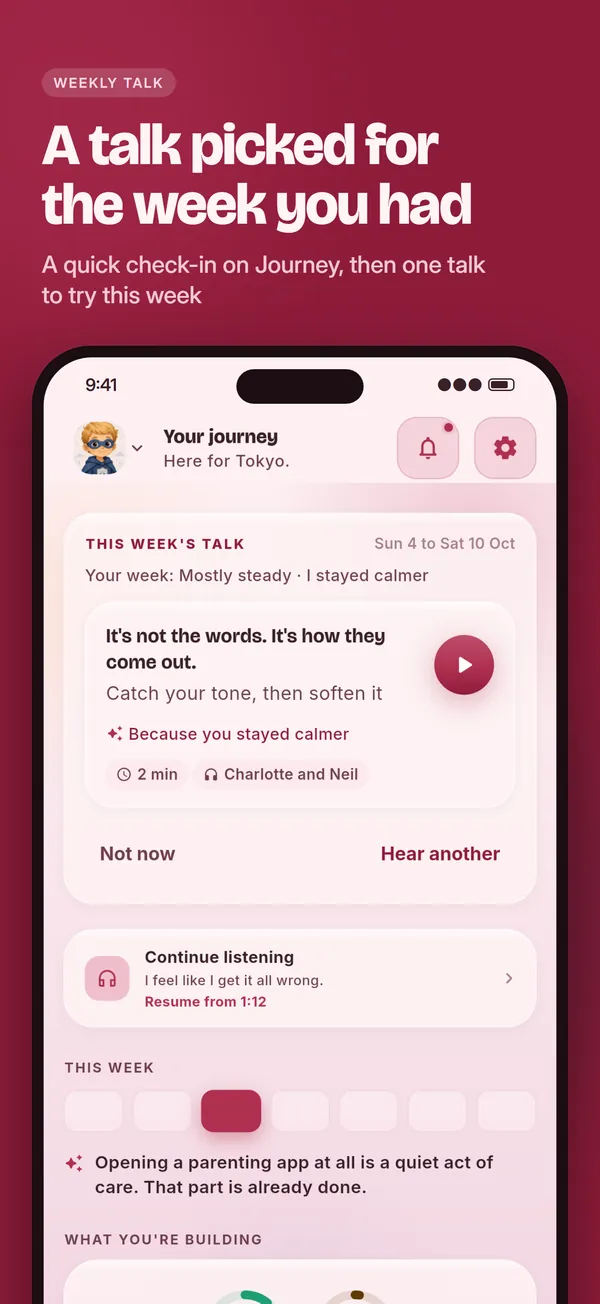
  • A talk picked for the week you had
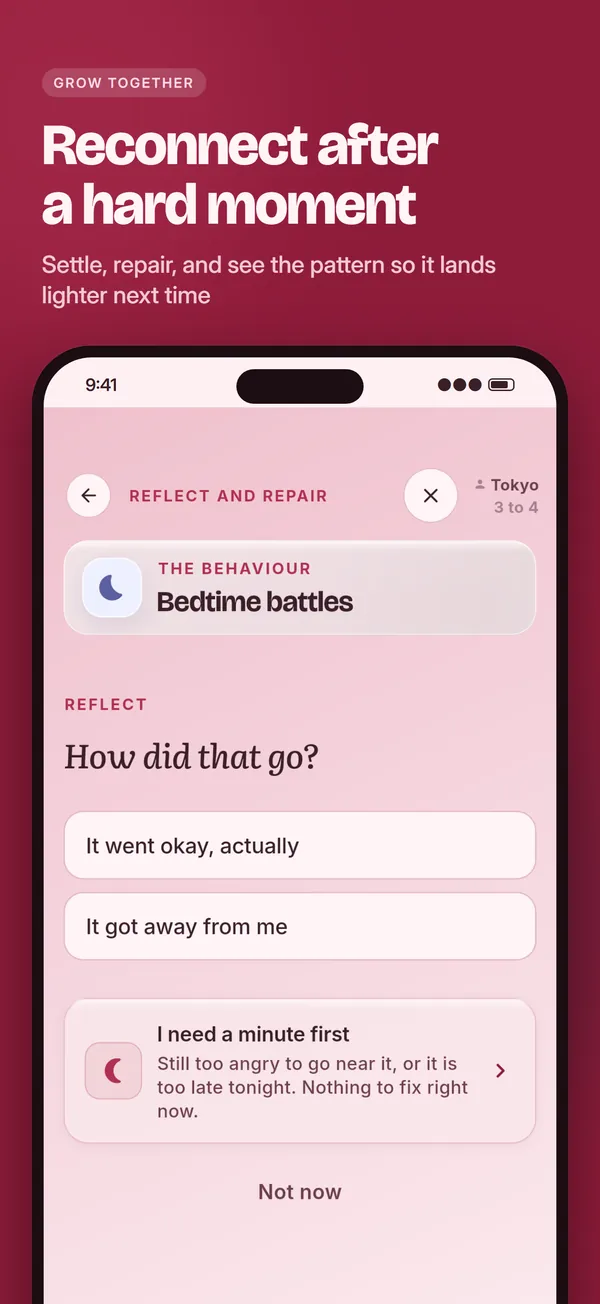
  • Reconnect after a hard moment
  • Print your calm kit for the fridge
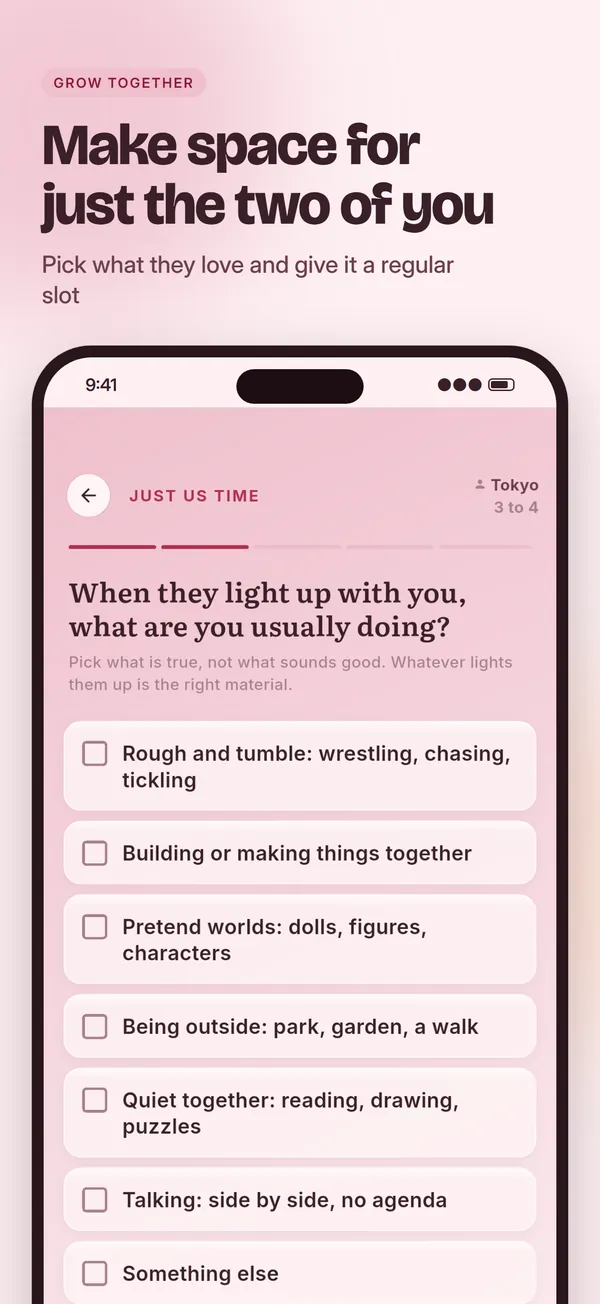
  • Make space for just the two of you
Early reviews

What the first parents are saying

Early reviews from the App Store and Google Play, quoted as written. We hide reviewers' names to protect their privacy.

★★★★★

It works!

My daughter is a fussy eater. I used to read a lot to get her to eat. Tried Frazzle. Built a personalised plan for her. To my surprise, it became easier to get her to eat. The app recommended that I eat the same food infront of her and she will notice me and follow suit. It worked!
Name hidden.App Store · Oct 2026 · Canada

★★★★★

Well personalised. Building your own plan gives this app an edge from the generic solutions out there. I used to use chatgpt for advice but it required lots of prompts to get a suitable and personalised solution.
Name hidden.Google Play · Sep 2026

★★★★★

Quite helpful

I have a 7 year old son and 4 year old daughter. While my son now has fewer meltdowns, my daughter has one almost daily. Sibling fights are a regular occurrence too. Frazzle helped me approach them in a different way. And the results are encouraging. My home is definitely calmer. My daughter also refuses everything I ask for. I made a plan and set a reminder. Helps me follow a structured approach rather than relying on improvisation.
Name hidden.App Store · Sep 2026

★★★★★

I liked the instinct-building part. Because in the moment, when your child is upset, you don’t really stop and think through what you’ve read. You just go with your default response. Even if you know there’s a better way. So practising it beforehand makes sense. Helps the calmer response come more naturally. I think that’s what could make Frazzle different.
Name hidden.Google Play · Sep 2026

★★★★★

Useful in preparing for tough moments

Makes me feel more confident to tackle difficult situations. It gives helpful advice but also personalises it and the games are top notch!! Great to build the instinct. As a UI/UX developer myself, I can tell a lot of thought has been put into it to make it easy to navigate, interactive, and valuable.
Name hidden.App Store · Sep 2026 · Australia

★★★★★

My kid is now older. he is 9, so most of the scenarios we do not experience. would have loved it a couple of years ago. but the screen time personalized plan has been gold. thanks a lot!!! started to think of screen time battles in terms of skills, relationship and transitions. changed our approach.
Name hidden.Google Play · Sep 2026

★★★★★

Parent oriented app

one thing I liked about this app is, that its for parents, not something you can hand to the child. It doesn’t increse child’s screentime, and is very handy for the parent at time of difficulty. Its parents who should know what to say and do. These skills are needed by parents and Frazzle helping parents in this makes sense.
Name hidden.App Store · Sep 2026

Every review here is a real 5-star store review from September and October 2026. These are individual experiences, not a measure of how well Frazzle works for every family.

Five minutes a day

Swap 5 minutes of scrolling for 5 minutes of Frazzle

Same phone, same five minutes on the sofa. This time you come away with something ready for tonight.

5 minutes of scrolling

Another reel, another tip

  • A clever tip you'll have forgotten by 6pm
  • Someone else's family, someone else's child
  • Nothing ready for when it actually kicks off
  • The same fight tomorrow night
5 minutes of Frazzle

Something ready for your child, tonight

  • The words to say when it kicks off, for your child's age
  • A short plan for the battle that keeps coming back
  • A two-minute talk or game that helps the calm response stick
  • A reminder at the time you choose, before the moment

What five minutes a day can help you work towards

Some of this can help tonight. Others build slowly, the way any habit does. Each one is linked to what the research found, with how solid that finding is.

Tonight

You know what to sayYou've seen the words already, so they're there when you need them.StrongPractising a response when calm is a core technique of the best-tested parent training. Kazdin, The Kazdin Method
Fewer repeated ordersSay it once, calmly, with a plan for what happens next, instead of asking louder each time.ModerateRepeating a request over and over makes children less likely to do it, not more. Kazdin, The Everyday Parenting Toolkit

In a few weeks

The calm response gets easierAt first it feels like reading a script. With practice it starts to come without thinking.StrongRepeating a new response strengthens it, like learning to ride a bike. Campbell & Stauble, Tiny Humans, Big Emotions
Less guilt after a bad dayRough moments still happen. What changes is that you know how to make up afterwards.StrongEven loving parents are in tune with their child about a third of the time. Repairing the misses is what builds a secure bond. Tronick's research, in Harwood, Raising Securely Attached Kids

Over months

Calm they can borrowA steadier you gives your child something steady to lean on while they learn to settle themselves.ModerateIn a Melbourne study, parents who stayed better regulated had better-regulated toddlers. Edvoll et al., 2023
A closer relationshipA family that can have a hard day and still feel close. That's the goal, more than any one behaviour.StrongIn a Welsh trial of a full parent programme, families' gains were still there 18 months later. Bywater et al., 2009

Honest note: these findings come from research on parenting approaches and full programmes, not from studies of Frazzle. Frazzle uses the same ideas in short daily doses. See all the benefits and sources

Fit it into your routine

Tie it to moments you already have

New habits stick best when they're small and hooked onto something you already do. Pick one or two of these, not all of them.

  1. Kitchen Table Talks list, picked for youOn the school runHear one talkAbout two minutes, with notes saved for later.
  2. PlayBook practice roundWhile the kettle boilsPlay one roundA short PlayBook game on the situation you find hardest.
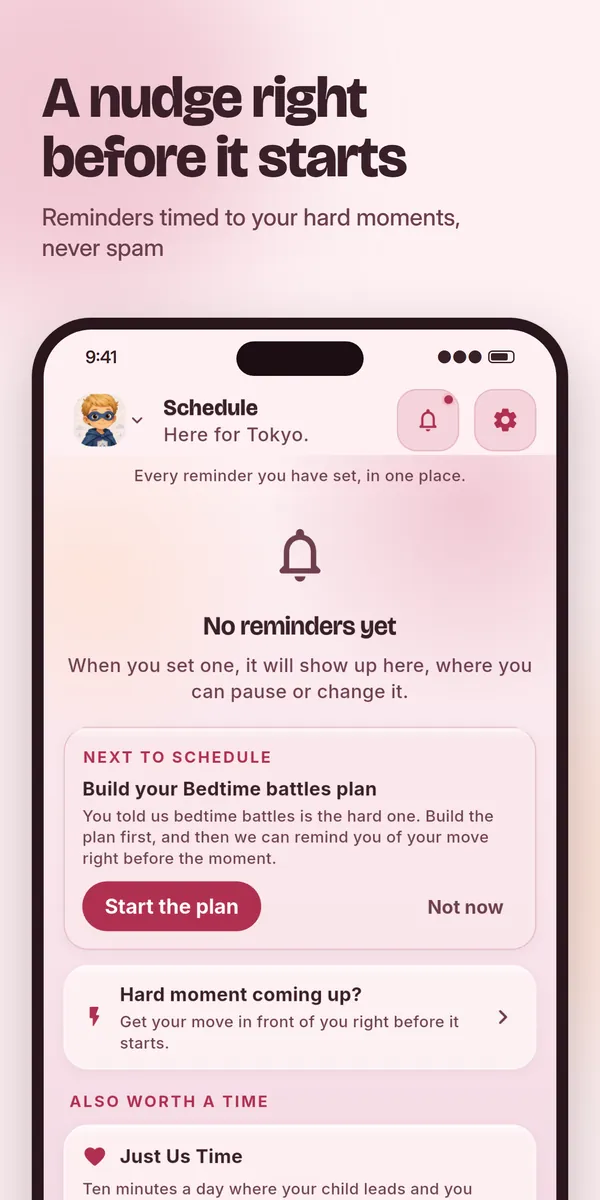
  3. Schedule tab: a nudge right before the hard moment startsBefore the hard hourYour plan arrivesOne reminder at the time you pick, with your move for tonight.
  4. Calm Kit Use now: one thing to offer and the words to sayWhen it kicks offTap Use nowOne thing to offer and one line to say, nothing to read.
  5. Reflect and repair after a hard momentAfter lights outRepair and resetMake sense of a rough one and plan one change for tomorrow.
"When X happens, I'll do Y"

Deciding in advance exactly when and where you'll do something makes people much more likely to follow through. Reminders in Frazzle are built around that.

StrongGollwitzer & Sheeran, 2006, a review of 94 studies
Start tiny, anchor it

Attaching a very small new habit to an existing routine, like the school run, helps it survive busy weeks.

ModerateFogg, Tiny Habits; Clear, Atomic Habits
Little and often

A few minutes on most days beats a big effort once in a while. A missed day doesn't undo the work, so aim for most days, not a streak.

StrongKazdin, The Kazdin Method; Lally et al., 2010
Break the loop of escalation

Why the same fight keeps getting louder

Know what to say now. Practise for next time.

Most battles run on a loop that neither of you chose. A small ask, some push-back, both of you turn it up, and someone gives in. Whichever bigger reaction ended it is the one you both learn, so next time starts louder. It isn't anyone's fault, and it can be changed from your side.

The push-back loop, and where Frazzle steps in Four steps in a circle: a small ask, push-back, both turn it up, someone gives in, which leads back to a louder small ask next time. Frazzle steps in at each point: plan the ask, notice the pull, one calm line, and hold it kindly then repair. 1. A small ask 2. Push-back 3. Both turn it up 4. Someone gives in Next time starts louder
  1. Before 1Plan the ask

    PrepLab helps you set things up so the ask lands: warning before stopping, a choice inside the limit, the right time of day.

  2. At 2Notice the pull

    PlayBook games train you to spot your own urge to snap or give in, a beat before it takes over.

  3. At 3One calm line

    Hard Moment Help and Calm Kit give you one thing to say and one thing to offer, so you can stay steady instead of louder.

  4. After 4Hold it kindly, then repair

    Keep the limit without a fight, and if it went badly, Work Through It helps you make up and change one thing.

Both sides learn the loop

Researchers who watched families at home found escalating exchanges end when one side backs down, and the bigger reaction that ended it gets stronger. The child is shaping the pattern as much as the parent.

StrongPatterson's home studies, in Kazdin, Parent Management Training
Stress sends us back to habit

Under stress, people lean on well-practised habits rather than on what they know they should do. That's why reading a tip isn't enough, and practice is.

ModerateSchwabe & Wolf, 2009
Connection before correction

Children can borrow a parent's calm while their own ability to settle is still growing, which is why the calm line comes before the lesson.

ModerateEdvoll et al., 2023; Siegel & Bryson, No-Drama Discipline
What change looks like

Change isn't a straight line

Most parents expect steady progress. Real change usually wobbles first, dips, then climbs and levels off. Knowing that makes it easier to keep going through the bumpy part.

How change usually happens, compared with what we expect An illustration over about three months. A dashed straight line rises steadily, which is what most people expect. The real curve dips in the first two weeks, climbs from week three, dips again for a rough week around week six, then rises and levels off near the top after about two months. Feels automatic StartWeek 3Week 6Week 93 months Calm response comes first What we expect What usually happens 1 2 3 4
An illustration of a common pattern, not data from Frazzle users. Everyone's timing is different.
  1. 1
    It feels scripted at first

    New words can feel awkward or fake. That's normal for any new skill, and it fades with practice.

    Campbell & Stauble, Tiny Humans, Big Emotions
  2. 2
    It can get worse before it gets better

    When a protest stops working, it often gets bigger for a day or two before it fades. It's a sign the old pattern is being tested, not that you're failing.

    Kazdin, The Kazdin Method
  3. 3
    A rough week isn't a reset

    In a study of how habits form, missing the odd day didn't undo people's progress. Pick it back up the next day.

    Lally et al., 2010
  4. 4
    It starts to feel automatic

    In the same study, new daily habits took a median of 66 days to feel automatic, anywhere from 18 to 254. If it takes a month or two, you're on track, not behind.

    Lally et al., 2010

Frazzle's Journey tab shows the effort you've put in, never a score, so the bumpy part doesn't feel like failing. See what's in the membership

One membership

Six ways in. One membership.

Some things are free to explore. A membership unlocks all of it, for every situation and every age from 2 to 9.

  • Calm KitCalming ideas made for your child, ready to use and to print.
  • PrepLabA plan for the routines and struggles that keep coming back.
  • Kitchen Table TalksShort audio talks with notes and something to try.
  • Hard Moment HelpWhat to say and do right now, with coaching audio.
  • Same PageTalks for two grown-ups who see it differently.
  • PlayBookShort games to practise the response you want.

Plus, to keep you going

This week's talk card on the Journey tab
This week's talk

A quick check-in about your week on the Journey tab, then one talk from the Kitchen Table Talks library picked for the week you had, with something to try. It's free, and it waits for you in the app rather than sending a notification.

  • Work Through ItReflect after a hard moment and repair without blame.
  • Just Us TimeIdeas for one-on-one time, matched to your child.
  • RemindersYour plan, at the time you pick, before the moment.
  • JourneySee the effort you've put in, without scores.
Why trust it

Where the ideas come from, and what we can and can't claim

Frazzle turns established parenting approaches into short, usable tools. Here is which ideas shaped which tools.

  • Hard Moment Help and Calm KitStaying calm first and helping a child come down from big feelings, drawing on work like Siegel and Bryson's on co-regulation and Gottman's on emotion coaching.
  • PrepLabPlanning ahead, predictable routines, clear limits and attention for what goes well, ideas found in parent programmes such as The Incredible Years, PCIT, Triple P and Alan Kazdin's work.
  • Kitchen Table Talks and Same PageWritten from a bank of parenting books and studies. Where the research is mixed, the talks say so, and Same Page presents both sides rather than picking one.
  • PlayBookLearning science: short, repeated practice and recalling a response, as described in books like Make It Stick, so it's easier to reach for later.

What this does and doesn't mean. The programmes above were studied in their own form, usually with a trained practitioner, not as an app. Frazzle has not been evaluated in a clinical trial, so we don't claim it will produce their results. It offers general parenting guidance and is not medical advice. If you're worried about your child, talk to your doctor or health visitor.

Why we built it

What 90 early parents told us

66%

want help staying calmer in the hard moment

55%

don't know what to say when it's actually happening

60%

said their own reaction is the hardest part

From a short survey of the 90 parents who signed up early for Frazzle in 2026, answered by 83% of them. Parents could choose more than one answer, so the figures add up to more than 100%. It describes what parents find hard. It is not evidence that the app works.

Private by design

Your family's answers stay on your phone

No accountNo sign-up, no email, no password.
No real namesYour child gets a city nickname and an age range, not a birth date.
Personalised on your devicePurchases go through your app store, and audio downloads from our servers. Read the privacy policy.
Questions

Good to know

Who is Frazzle for?

Parents and carers of children aged 2 to 9. Advice is worded differently for younger (2 to 4) and older (5 to 9) children, based on the age you pick.

What can I use for free?

Without subscribing you can build your first Calm Kit, use the guide and plan for the moment you pick at setup, hear This week's talk and the starter talks marked Free, and start Same Page. Everything else is part of the membership.

Who gets the 14-day free trial?

Eligible new subscribers, through the App Store or Google Play. You start it inside the app, and the store confirms whether you're eligible before anything is set up.

How much does it cost, and does it renew?

It's a monthly or yearly subscription. The price for your country is shown in the app and by your store before you confirm. It renews automatically at that price until you cancel.

How do I cancel?

Anytime, in a few taps. On iPhone: Settings, then your name, then Subscriptions. On Android: the Play Store, then your profile, then Payments and subscriptions. Cancel at least 24 hours before the trial ends and you won't be charged.

Do we have to listen to Same Page together?

No. You can listen together on one phone or on your own. Starting alone is fine, and each talk still ends with a version of the next step you can try.

Do the talks work without signal?

Talks stream the first time you play them. Talks you've played recently are kept on your phone, so they usually replay without a connection.

What happens if I get a new phone?

Your subscription belongs to your App Store or Google Play account, so you can restore it on a new phone from Settings in the app. Because there's no account, your answers and plans live on the phone you made them on.

Is it therapy or medical advice?

No. Frazzle offers general parenting guidance. If you're worried about your child's development or wellbeing, please talk to a doctor or health visitor.

Get Frazzle

Start with what's hardest this week.

For parents of children aged 2 to 9. On iPhone and Android.

14-day free trial for eligible new subscribers, then auto-renewing. Cancel anytime.

Where to start Get Frazzle